
Home for Christmas. Still Recovering in January.
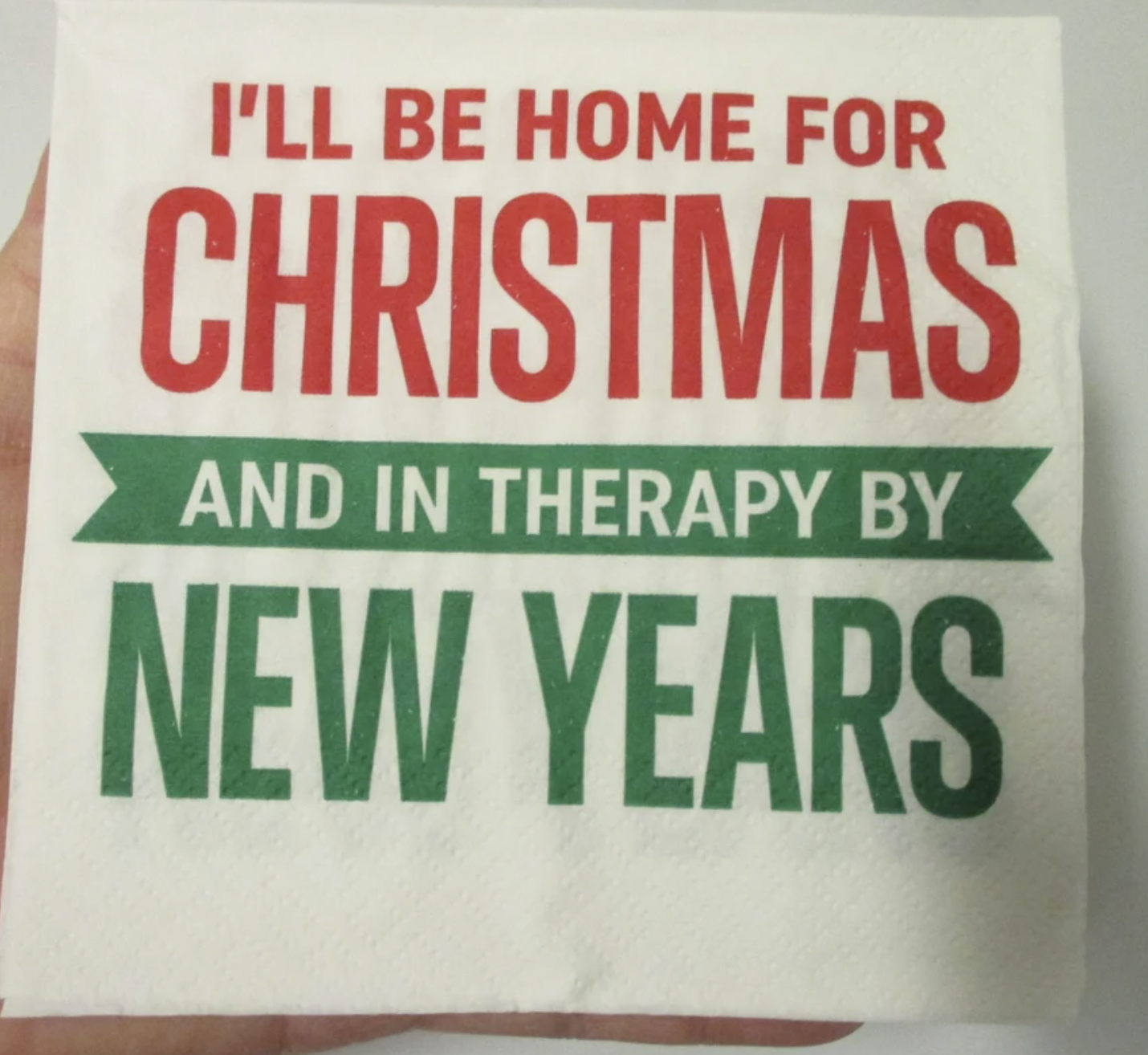
I recently received a napkin that said: “I'll be home for Christmas and in therapy by New Year's".
It made me laugh — and then it made me pause. Because for a lot of people, that’s not a joke. It’s a whole lived experience.
For some people, Christmas feels fun and easy. For others, it feels like stepping back into the same space they’ve spent years trying to heal from — just with more lights.
Because family time doesn’t just bring people together — it brings history together. Old dynamics. Unspoken expectations, unspoken hurts. The pressure to “just be fine.” The comments that land like a punch but get brushed off like a joke. Even when nothing “big” happens, your body still knows. Because your nervous system remembers.
When you’re around family, your brain doesn’t only track what’s happening now — it scans for what used to happen. So you might notice yourself slipping into old patterns: people-pleasing, over-functioning, keeping the peace, shutting down, getting snippy or feeling like you need a few days to recover afterward.
That’s not you being “too sensitive”. That’s your system trying to protect you.
And for many people, the hardest part isn’t even what happened during the visit — it’s the emotional hangover after. The crash. The grief. The loneliness. The heaviness of realizing you’re still carrying more than your share… or still wishing your family could be what you needed it to be.
That’s the part most people don’t talk about. The part where you get back to your real life and realize you feel off.
The part where you can’t shake the tension. The part where you’re asking yourself, "Why does this still affect me so much?"
If you relate to that napkin, here’s what I want you to know: it doesn’t mean you’re broken. It means your system is responding to something it has learned, survived, adapted to and held onto for a long time.
Here’s the most important thing I want to say: you don’t owe anyone access to you at the cost of your mental health. You can love people and still protect yourself. You can be kind without being available for disrespect, manipulation or emotional chaos. Boundaries aren’t punishment — they’re protection.
If Christmas was hard, don’t rush yourself into “getting over it.” Give your body time to come down. Sleep. Drink water. Move your body. Get quiet. Name what was true without minimizing it. And don’t make big decisions while you’re still flooded.
And you’re allowed to use that information to choose something different next time — whether that means therapy in the new year, firmer boundaries, different expectations or simply more compassion for yourself.
Sometimes Christmas gives us hope. Sometimes it gives us clarity. Sometimes it gives us both. If you’ve been thinking about therapy, you don’t need to wait until things are “bad enough.” Sometimes the holidays are just the moment that makes it obvious: something still hurts, and I’m ready to take care of it.
If you want support, we’re here. Therapy isn’t about blaming your family or replaying the past forever — it’s about helping your nervous system feel safer, helping you understand your patterns and giving you real tools so next time you’re not paying for the visit with a week-long crash.